Showing posts with label 1969 Ivy Green Mercury Cougar. Show all posts

Saturday, March 19, 2011

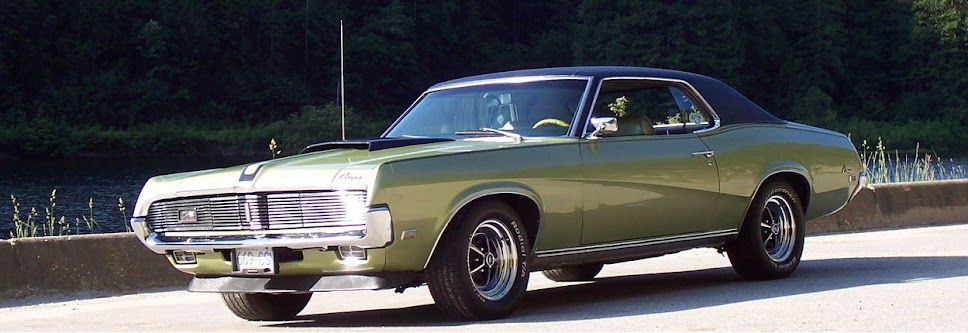
1969 Mercury Cougar Kelowna BC Canada


The Mercury Cougar was wider, longer, and heavier for 1969, but a new convertible body style joined the two door hardtop and the Cougar received a serious performance boost mid year with the introduction of the Eliminator package.


The Eliminator came standard with the four barrel version of the Windsor 351 cid V8, rated at 290 bhp. Optional was a full range of engines from the Trans Am inspired solid-lifter 302 seriously under-rated at 290 bhp and the 428 Cobra Jet, with and without Ram Air. In all out acceleration, the 290 bhp 302 cid V8 was overmatched by the Cougar's weight, but the 428 Cobra Jet benefited from the relatively generous wheelbase.


Grip was better off the line that the Mustang and 1/4 mile times were just as good. Standard Eliminator equipment included F70x14 in Goodyear Polyglas tires on styled steel wheels with blank center caps.


The Eliminator was also available in Drag Pak guise with an oil cooler and a 4.30:1 Detroit locker. Eliminator didn't use the shaker hood; its standard scoop was functional only when Ram Air was ordered. A black-out grille, side stripe, and front and rear spoilers enhanced the look, and Mercury offered the Eliminator in a palette of "high impact" blue, orange, and yellow exterior colors.


Even more performance was available over the dealer's parts counters, which offered not only headers and dual quads, but such exotic hop-ups as deep-sump oil pans and quadruple-carb Weber setups. All from Mercury!

Production:
2D Hardtop: 66,331
Convertible: 5,796
XR-7 2D Hardtop: 23,918
XR-7 2D Convertible: 4,024

Engines:
302 V8 290 bhp.
351 V8 250 bhp.
351 V8 290 bhp.
390 V8 320 bhp.
428 V8 335 bhp @ 5200 rpm, 440 lb-ft @ 3400 rpm.

Performance:
428/335: 0-60 in 5.6 seconds, 1/4 mile in 14.1 seconds @ 103 mph
.

By Donald Robichaud
Share

Monday, June 29, 2009

Westside Daze 2009 Classic and Antique Car


Canada Day International Classic and Antique Car Show 'n Shine

Wednesday, July 1, 2009
10:00 to 3:00
Johnson Bentley Memorial Park
WESTBANK, BC
FREE Registration at 8:30 AM
(See Map)
Pre-registration NOT required but would be nice!
Car Show Categories

By Donald Robichaud


Share

Friday, June 19, 2009

3 Valley Gap Car Cruise 2009 Video

Share

Monday, June 15, 2009

Three Mercury Cougars at Three Valley Gap


On June 12th 2009 the Okanagan Mustangs and Fords car club had a cruise up to 3 Valley Gap in Revelstoke BC. After a great day of cruising we arrive at 3 Valley Gap Chateau for an evening of entertainment.
Upon arrival I ran into Robert Nowland and his Rocky Mountain Life Insurance 1969 Mercury Cougar. This was obviously destiny as I had just read about the Rocky Mountain Purple Cougars in April of 2009.
Linda Beauregard/Jackson was on the trip with her 1971 Cougar so we took the opportunity to take pictures of this rare occasion.

Don Robichaud
Rocky Mountain Life Insurance 1969 Mercury Cougar
In 1969 the Rocky Mountain Life Insurance of Alberta, special ordered cars for their top salesmen. In all 98 cars were ordered with special WT9083 (purple) paint. White vinyl roof, power steering tilt and tilt away wheel, 351 W 4 barrel and other special options. In 1970 when the company was dissolved, these purple and white 1969 Cougar XR7’s were shipped from Universal in Calgary for dealers to sell.

Rocky Mountain Life Insurance Special Options
Vehicle ordered with the following options. White vinyl roof, immersion heater, FMX Cruise-O-Matic Transmission, E78X14 Tires, White sidewall tires, Power front Disc Brakes, Power steering, Tilt & tilt away steering wheel, AM/8-Track Stereo Radio, Tinted glass complete, Deluxe Belts/Warning Light, Heavy Duty Battery, Door Edge Guards, Wire Wheel Covers & Front Bumper Guards.

Serial numbers start with 9F93M followed by the 5 number sequential serial numbers, Engine is 351-4V Winsor. Interior is Code FA - White leather Bucket Seats W/ Black Appointments. DSO is a 6 character code starting with A6 and the Special order number.


Share

Monday, June 1, 2009

A&W Show and Shine the West Kelowna Cruisin the DUB


Ron Chelsberg is proud to hold a by-weekly car Show and Shine the West Kelowna Cruisin the DUB. The objective is to attract West Kelowna car enthusiast through July and August.

This will happen at the A&W West Westside parking lot. The car show is held in conjunction and supported by the Okanagan Mustangs and Fords.

Dates will be July 9th 2009, July 23rd 2009, August 6th and August 27th 2009. For more information

Contact Bush Halpenny at (250) 718-7727 More details to Follow Share

Sunday, April 19, 2009

1969 Mercury Cougar XR7 Convertible "R" code 428-4V CJ Ram Air engine


Rare "R" code 428-4V CJ Ram Air engine, Factory A/C, am/fm radio, tilt steering wheel, leather seats, 78,330 three owner miles.


Share

Restored 1969 Mercury Cougar one cool cat


When Tony Miglecz takes his tasty '69 Mercury Cougar to show-and-shines and cruise nights, he says "a lot of people just walk right on by. They think it's a Mustang."
On its introduction, the Mustang caused a sensation - and created a new segment for high-styled, small-sized personal cars. It didn't take long for other brands to jump on the ponycar bandwagon and one of those brands was Ford's companion brand, Mercury.
The tall foreheads at Ford Motor Company thought they discerned a gap in the product lineup between the Mustang and the Thunderbird. What was needed, they thought, was a car between the two in size and price that offered more luxury than the Mustang. They decided to have Mercury dealers sell the new offering, and called it the Mercury Cougar.
Introduced for the 1967 model year, the Cougar sold 150,893 copies in that first year. The 1968 style was very similar to that of the first-year car, but the '69 version was quite different. Sales that year were down, to just over 100,000, perhaps because Ford had pulled back on the Cougar's very successful racing effort.
In 1990, Tony Miglecz was driving through Inglewood on his way to look at a big-engined Ford Torino. As he passed a used car lot, he spotted a black '69 Cougar and ended up buying it. The two-door hardtop had just over 65,000 miles on it, but it was about to get some hard use.
"I drove it to the rig for five years," Miglecz says. "It's been out Forestry Trunk Road. It's been out to Grande Prairie and all areas north of Grande Prairie." While he was driving the car "all over Alberta," Miglecz says, he was rounding up good parts for its eventual restoration.
"Every year, I'd bring the car in and spend $1,000 on it," he says. Underneath, the car was improved with a negative wedge camber corrector, bigger front and rear sway bars and '71 Torino brakes. "It was a 351 Windsor two-barrel single exhaust car, so right away I got the dual exhaust on it and put on an Offenhauser dual-plane manifold with a four-barrel carb."
Ford products came with one of two 351 cubic inch engines in '69 - either the 351 Windsor or the 351 Cleveland, named after the engine plants where the power plants originated. The Cleveland, Miglecz says, was the engine of choice. "They make really good power. They sound completely different and it's a nice motor, too, to look at."
The Cougar's original Windsor engine did provide one benefit, he admits. "The undercarriage was in good shape. That's part of the 351 Windsor thing because the rear seal used to leak like crazy. On the way up to Grand Prairie I used to stop at Drayton Valley for a tank of gas and a litre of oil. That's what saved the floor - that 351 Windsor slobbering all over it."

Once he decided to get to work on the Cougar, Miglecz started using all those parts he had collected. "I always wanted a Cleveland (with a) four-speed," he says, and that is what now powers the car. One door that he had collected along the way proved to be something of a mystery as it was painted an odd purple colour that was never offered on production cars. What Miglecz discovered was that the door had come from one of 150 cars all painted the same shade and used by an insurance company.
The car, originally black, is now gold, he confides, because there used to be another black '69 Cougar in town that sometimes was driven in an overly-spirited manner. "I got into some trouble a few times because of that," Miglecz explains, "so I figured I'd change colours.

"When you get off work from the rigs, sometimes you're used to graveyards," Miglecz says. "I'd get up at two in the morning and go out to the garage. I always figured it was a successful week if I got one part done."
Something he found a bit liberating was that, unlike more popular cars with large fan bases, some of whom are purists that disparage any change from a car's original configuration, Cougars are just about unknown. This freed him to make some non-stock changes like the side scoops on the car, which came from a Mercury Marauder.
"When I put that side scoop on, 98 per cent of the population doesn't know that it doesn't belong on the car," he says. "I figured I could do anything to it. It's exactly the way I like it. I build them how I like them and if other people like them too, I'm glad to hear that."
Share

1969 Mercury Cougar - Cat Balue


The blue '69 Mercury Cougar shown here belongs to Jason Bushman-a 19-year-old, dyed-in-the-wool Blue Oval fan from Edmonds, Washington. The good-looking cat has been lovingly restored by Jason and his father, with a little help from the folks at the Northwest Pony Shop. Jason tells us he was born into a Ford family and that he drives this car every day to school and to work. He and his dad certainly had their work cut out for them, as the '69 Cougar didn't always look this good.

The Bushmans discovered this car sitting forlornly at a construction site, the victim of a recent theft and recovery. All the glass had been smashed out and the upholstery was ripped to shreds, but they were not discouraged. For one thing, the Cougar still has its original 351 Windsor engine. Five hundred dollars did the trick for the pink slip, and then the massive amount of refurbishment work began.

The first thing to do was to strip the whole body down to bare metal. Once this was accomplished, Jason and his dad did most of the bodywork at home in the family driveway. The Northwest Pony Shop completed the details on the bodywork and the Cougar was painted '70 Mustang Grabber Blue in place of the original light-powder-blue color. Straight, crisp lines now show on the car's body, along with a perfect grille with the famous hide-away headlights. A fresh set of 14x7 Magnum 500 wheels shod with Pirelli rubber completes the outside look

The Cougar was originally equipped with the deluxe interior package, so new deluxe upholstery and carpeting bring things up to spec. The interior's original instrument cluster is in good condition and the OE Rim-Blow steering wheel is still present. The car was also equipped with the rare rear-window defogger option, while the sound department has been upgraded with an Alpine amplifier, a Sony CD player, and Pioneer speakers and sub.

When Jason and his family discovered the car, it had only 83,000 original miles. As the 351W engine ran just fine, they decided to leave well enough alone-for now. They carefully cleaned and detailed everything in the engine compartment. The engine looks good, sporting a set of Cobra rocker covers and a stock air-cleaner assembly. The only performance upgrades so far include an Edelbrock Performer 351 intake manifold and a 650-cfm, four-barrel carb.

The mild-mannered Windsor mill is connected to the original FMX three-speed automatic transmission, and power then goes back to a nine-inch axle with 3.00:1 gears. An Optima battery adds peace of mind. The whole package now runs low 15s.

All this hard work resulted in a First-Place finish at the Mustang Roundup teen class. The blue cat was also recently displayed at the Seattle Roadster show. We think it's safe to say that Jason does indeed come from a Ford family, as other notable Blue Oval cars in the Bushman stable have included a '69 Cougar Eliminator and a '67 Mustang 2+2. We think Jason sure is a lucky guy to have this great car, as well as such super support from his family.
This Blue Cougar Makes Us Green With Envy
By Wayne Cook
Photography by Jeff Ford
Share

Friday, March 13, 2009

1969 Mercury Cougar "Black Cat"


Share

Saturday, January 17, 2009

Two Cougars TV Commercial - Hagerty Car Insurancee

Share

Tuesday, December 9, 2008

1970 Mercury Cougar Eliminator

Share

Saturday, November 29, 2008

Kelowna Daily Courier - Was the Mercury Cougar a better Mustang?

At posted from the Kelowna- Daily Courier -Friday November 8th 2008 -Was the Cougar a better Mustang?
Donald Robichaud - 1969 Ivy Green Mercury Cougar

Pity the poor Mercury-Lincoln dealers back in the mid-1960s.
Flush with acres of Continentals, Park Lanes and Montclairs, not to mention a few assorted econobox Comets, these folks could only stare in hopeless exasperation as eager prospects flocked down the road to the nearest Ford store.
Why?
The new Mustangs had arrived.

The birth of Lee Iacocca’s baby had resulted in a severe case of mass automotive hysteria and ushered in an era of pony-car madness. Suddenly, every North American manufacturer was chomping at the bit to cash in on this latest car craze.

But Ford’s long-suffering Mercury retailers would have to wait nearly two-and-a-half years after the Mustang’s ground-breaking introduction before they could add some sporty car spice to their meat-and-potatoes lineup.

When the Mercury Cougar finally arrived in the fall of 1966, it was one of several fresh entries into the pony-car race, including the Chevrolet Camaro, Pontiac Firebird and Plymouth’s clean-sheet second-generation Barracuda.


Mercury took a decidedly different approach with the Cougar. Early advertising touted its luxury car leanings with the tag line, “The Fine Car Touch inspired by the Continental.” Also promoted was the Cougar’s comfortable ride and equally plush bucket seats.


The new “Cat” was built using a Mustang chassis, but its wheelbase had been increased by about seven centimetres. The extra distance created a far more hospitable environment for rear-seat passengers and added to the car’s passenger-friendly ride.

Visually, the Cougar was a pleasant piece. Along with its must-have long-hood, short-deck styling, the car featured unique hidden headlights that remained cloistered behind the front grille until pressed into service. But the real knockout feature was the car’s sequential rear signal lights that strobed in the appropriate direction whenever the stalk indicator was flicked.

Unlike the Mustang, the Cougar was available only with V8 power. The base engine was a 200-horse, 289-cubic-inch unit, while a 225-horsepower, four-barrel-carb version was available as an option.

If this wasn’t enough, the optional GT package featured a more muscular 390 cubic-inch V8 stuffed between the Cougar’s shock towers. Midway into the 1967 model year, Mercury introduced the Cougar XR-7, complete with full gauges, woodgrain interior trim, leather seats and other fancy bits.

First-year sales of more than 150,000 Cougars proved the public was hungry for a ponycar with a little more flair and substance than the rest of the field.
For 1968, the Cougar received the new 302 cubic-inch V8, as well as the horsepower-abundant 428 and racing-oriented 427 cubic-inch V8 options that cranked out 335 and 390 horsepower, respectively.

That year also saw the creation of one of the rarest of Cougar models, the XR7-G. The “G” stood for racing legend Dan Gurney. This model included a special fibreglass hood complete with scoop (non functional, though) and racing-style locking pins, fog lamps, special alloy wheels and interior trim. Only 619 XR7-Gs were shipped from the factory and, of those, slightly fewer than 200 went to Hertz to be used as rental units.

In 1969, the mildly restyled Cougar family grew to include both a base and XR-7 convertible. You could still order the big-block 428 motor, but the raunchier 427 was trimmed from the order sheet. A new 351 cubic-inch-engine series became available that year, with output ranging from 250-300 horsepower.

The hot setup that year became the Eliminator, with its wilder colours, look-at-me decals and striping plus a rear-deck spoiler. All of these items might have worked on any other pony car, but the Eliminator package only served to make the sleek, sophisticated Cougar look decidedly undignified.The Cougar remain basically unchanged through 1970, although the 390 V8 had finally disappeared from sight.

Sales, however, dropped as pony-car buyers shifted to more high-performance offerings that were being heavily marketed by the competition. This seemed to be the signal for Mercury’s product planners to turn the Cougar into a true boulevard cruiser.

Although the 1971 version continued to used the Mustang’s platform, the car became significantly bigger, stouter and pricier, with more luxury touches included as part of its standard features.

But for four solid years, the Cougar represented a softer, more eloquent interpretation of the pony-car revolution and gave its proud owners a taste of how future “personal luxury” cars would evolve.

These days, the Cougar is rapidly gaining in popularity among collectors who consider its unique and tasteful styling and plenty of on-tap power to be a cut above the Mustangs, Challengers and Camaros of that era.
It’s funny, but those are the exact same reasons the original Cougar became such a sales success in the first place.

Malcolm Gunn is a feature writer with Wheelbase Communications. He can be reached at wheelbase.ws/mailbag.html. Wheelbase Communications supplies automotive news and features to newspapers and websites across North America.

Share

Sunday, August 17, 2008

Donald Robichaud - My Favortie cars

Since 1996 I have taken and down loaded pictues of my favorite cars. They range from Hot Rods to classic drives of all decades. In the last five years I have taken many pictures from the Okanagan.

Share

Friday, July 4, 2008

1969 Ivy Green Cougar - Engine Roars!!!!

Share

Tuesday, June 17, 2008

Mercury Cougars 1967 to 1970

Share

Thursday, June 5, 2008

Mercury Cougar has been mostly overlooked by collectors!!!


1967-1973 Mercury Cougar
It was Motor Trend’s Car of the Year in 1967, and Car Life called it a “Mustang with class.” Yet the Mercury Cougar has been mostly overlooked by collectors, and this relative of Ford’s iconic pony car hasn’t yet ascended to the heights of valuation that many other muscle cars have. This is good news for the budget-minded collector, as it’s still possible to acquire a pretty nice Cougar for what would be a pittance in Hemi country.
The Cougar debuted for 1967 as a two-door hardtop, with an aerodynamic roofline and hide-away headlights. It was based on the Mustang, but with a stretched wheelbase and some suspension modifications for a more comfortable ride. Ford’s idea was to pursue the sports-luxury market, creating a serious rival for GM’s myriad upmarket muscle cars like the Buick Skylark GS and Oldsmobile 442.
To this end Cougars could be had with better appointments than their Ford-badged cousins, with simulated leather bucket seats, a wood-rimmed steering wheel, and a simulated walnut dashboard all offered. Yet the Cougar still had the traditional pony car look, with a long hood and short rear deck. Like with the Mustang, it was possible to find a trim level and drivetrain combination to suit any budget.
The base model came equipped with the venerable Ford 289, making 200 hp with a two-barrel carburetor. A three-speed manual was standard, though a four-speed manual and a three-speed automatic were available. An optional four-barrel setup bumped output to 225 hp, and the GT option got you a 390-ci V8 with a heavy-duty suspension. Halfway through the model year the XR-7 package was introduced, with a deluxe gauge set and a whole host of other interior upgrades.

For 1968, a rare XR-7 option package was available, the XR-7G. Named in honor of famous SCCA Trans-Am Series driver Dan Gurney, an XR-7G could be fitted with one of six different powerplants, and carried a fiberglass hood scoop, styled steel wheels with radial tires, fog lamps, racing-style hood pins and special emblems. A sunroof, the first ever offered by a car manufacturer, was optional. Hertz bought 188 of the 619 XR-7Gs produced, making this iteration among the rarest and most valuable Cougars. Standard power units in 1968 were 302-ci V8s making 210 hp, and the 390 output climbed to 325 hp. Power junkies could be sated by the GT-E option, pairing a 427-ci V8 making 390 hp with a Merc-O-Matic three-speed automatic transmission, along with suspension upgrades and power disc brakes. The 427 was replaced mid-year by Ford’s 428 Cobra Jet Ram Air; while rated for insurance purposes at just 340 hp, many have estimated its true output equivalent to the 390 hp of the 427.

The 428 CJ formed the basis for the fiercest production Cougar, 1969’s Eliminator. The ongoing Detroit horsepower wars were nudging the Cougar further from the luxury realm, and this package included a blacked-out grille, side stripes, a spoiler, and a number of garish color options. Underhood, the Eliminator used Ford’s 290-hp 351 Windsor as its standard powerplant, with the 428 optional. The CJ could propel the big Cougar down the quarter-mile in under 15 seconds, despite 1969’s restyling that saw the car’s proportions grow.

A convertible model was also introduced for 1969, an attempt to broaden the appeal of a no-longer fresh car whose sales were waning. Three more model years saw the Cougar continue to grow in size as its sales shrank. Engine options in 1970 included a list of classic Ford mills: the 351 Cleveland, the Boss 302, and the 428 CJ.

Mercury discontinued the Eliminator model for 1971, though a 429-ci CJ rated at 370 hp was offered. 1972 and 1973 saw engine “choices” shrink to just one, the 351. Just as in the rest of the muscle car market, these last Cougars were neutered by pollution regulations, so the big cat trod a new path more defined by luxury than power.

A collector in the hunt for a Cougar should understand that with so many different equipment packages and options and most parts readily available, there are a lot of cars out there that have been modified with equipment that wasn’t fitted when they left the factory. There is much less of a stigma associated with “clones” among Cougar enthusiasts than elsewhere in the muscle car realm, but you should still know what you’re buying.

If you’re shopping for a Dan Gurney XR-7G or a real GT-E, be sure there’s a paper trail associated with the car before you pay a premium. These models are the truly rare Cougars, with 619 XR-7Gs and 394 GT-Es produced. Know that a Cougar “Dan Gurney Special” is not the same thing as a real XR-7G, just a chrome dress-up package offered in 1967 and 1968. Like most muscle cars, engines determine a large part of a Cougar’s desirability. For 1969 and 1970 Cougars with the Cobra Jet engine, the fifth digit of the VIN should be either an R or Q.

With a large national club and an enthusiastic membership, more advice is readily at hand. If you are uncertain about a car’s authenticity, there are plenty of resources available—try starting at Marti Auto Works (martiauto.com), which offers production reports for all FoMoCo vehicles produced from 1967 to 1973.

Base Cougars are not scarce, so there is no reason to buy a car with any rust whatsoever. Cars requiring mechanical work are less of a problem, as standard Ford parts availability is excellent. Due to this support, and their inherent mechanical simplicity, a Cougar can make a great daily driver.

The market for Cougars is still growing. While they may never reach the peaks we’ve seen for other muscle cars, prices are following the general trend. For the XR-7G, GT-E and Eliminator, expect to pay in the $30,000-and-up range, depending on options and condition. But a standard Cougar, even an XR-7 with decent options, can still be found for $10,000 to $15,000. Convertibles carry the typical premium, but know that many of the more desirable options were not available on the droptop.

Regardless of the model, Cougars sell for chicken feed compared to the premium people are paying for the more popular pony cars. This likely won’t last for long, as we’re already seeing people step up and pay real money for “off-brand” muscle cars from the likes of AMC, Buick and Oldsmobile. Will Mercury be next?

Share

Wednesday, June 4, 2008

1969 Ivy Green Cougar at the 2008 Peach City Beach Cruise Pentiction BC

Share

Sunday, June 1, 2008

1969-1970 Mercury Cougar


The 1969-1970 Mercury Cougar was the second-series Cougar, with a longer, wider body on the same 111.0-inch wheelbase and two new convertible offerings. Styling was similar to 1967-1968, but more ordinary, particularly the grille. XR-7s continued to feature a full set of needle gauges and leather-faced seat upholstery as standard, and wore blackout grilles for 1970.

The former GT and GTE models were reduced to option packages available with or without XR-7 trim, but continued to pack big-block V-8s.A new variation was the Eliminator package for the hardtop, sporting appropriate tape striping, a rear decklid spoiler, wide wheels and tires, and a 300-bhp version of Ford's 351 V-8.

Like concurrent Mustangs, these were the last of the true ponycar Cougars.For 1971, Ford and Mercury both bulked up their ponycars, making them heavier and less agile, though more luxurious, than their predecessors. Styling became more like that of the mid-size Montego, which the Cougar was later based on.
  • Pluses of the 1969-1970 Mercury Cougar:Clean long-hood/short-deck styling
    Pleasant combination of performance and economy with small-block V-8
    High performance
    XR-7s are Milestone cars
  • Minuses of the 1969-1970 Mercury Cougar:Less distinctive styling and somewhat lower appreciation potential than the 1967-1968
    Some electrical headaches
    Rocker panel and floorpan rust
    Thirsty and nose-heavy
  • Production of the 1969 Mercury Cougar:2-door hardtop: 66,331
    Convertible: 5,796
    XR-7 2-door hardtop: 23,918
    XR-7 convertible: 4,024
  • Production of the 1970 Mercury Cougar:
    2-door hardtop: 49,479
    Convertible: 2,322
    XR-7 2-door hardtop: 18,565
    XR-7 convertible: 1,977
Specifications of the 1969-1970 Mercury Cougar:
Wheelbase, inches: 111.0Length, inches: 193.8 (1969), 196.1 (1970)
Weight, pounds: 3,219-3,408
Price, new: $3,016-$3,692 (U.S.)
Share