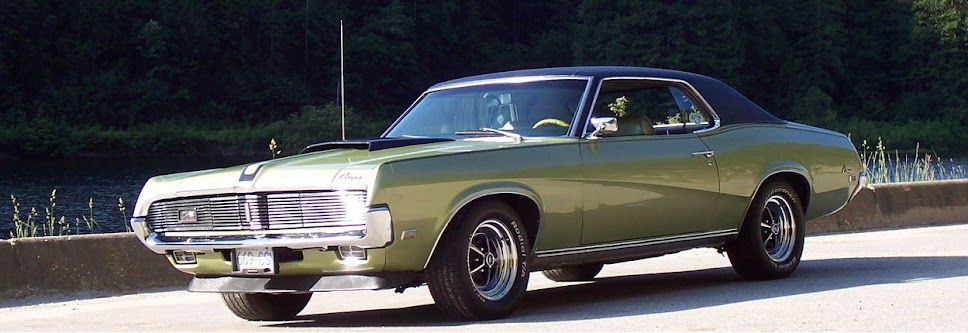
1969 Mecury Cougar Ivy Green - Before and after Pictures

Saturday, November 14, 2009

Mercury Cougar Holy Grail – West Cost Classic Cougars

In the past month I was on a road tour heading down to San Diego from Kelowna BC and as I headed into Salem Oregon I decided to visit West Coast Classic Cougars.
In the past few years I have procured many parts form West Cost Classic Cougars and I decided to visit this Holy Grail of mercury Cougars.
Don Rush the owner of West Coast Classic Cougars gave me and my wife a personal tour of his facility and I was very impressed with the size of his operation and the many parts that he and his team have parted out.
The very best of the trip was the viewing of a 1969 Mercury Red Convertible with an original Mercury CJ 428 engine which Don Rush was preparing for Barrett Jackson’s.
Dons hospitality was appreciated and his tip of heading down the Oregon cost was the highlight of our next day’s driving.
If you get the chance visit Salem Oregon, I recommend visiting West Coast Classic Cougars and say hi to Don Rush and his team.
Don Robichaud

Tuesday, September 15, 2009

1967–1969 Mercury Cougar: Polished Pony


When the Ford Mustang ushered in the pony car era in mid-1964, other domestic manufacturers took notice. The Mustang was an instant success and every division within the Big Three wanted a piece of that pie. Mercury was no exception.

Ford's sister company approached the project with an eye toward not only the Mustang, but toward the bigger, more luxurious Thunderbird as well. The new Mercury would fall somewhere in the middle. It would be aimed at a demographic slightly more sophisticated than the Mustang set, yet not so established as the typical Thunderbird buyer.

Development work commenced immediately, and the Cougar debuted in 1967, sharing the basic platform of the second-generation Mustang, though a bit bigger overall, including a wheelbase increased by three inches. It also shared some components with the Mustang, notably in its mechanicals and cabin, though it was better appointed and priced as such.

Styling was reminiscent of the Mustang shape, but a bit more flowing, with a rocker panel character line and a subtle crease above the front fenders, continuing along the top of the doors, and curving up into a broad C-pillar before ending at the rear of the car. A wide grille with vertical bars concealed the headlights, while a similar treatment at the back concealed the taillights.

The Cougar came only as a two-door hardtop and was an instant success, much the way the Mustang had been. The automotive press lauded it as a luxury sports car, and Motor Trend named it "Car of the Year" for 1967.

Standard power came from a two-barrel 289 V8 delivering 200 hp, though a four-barrel 289 with 225 hp was a popular upgrade. Four transmissions were available, including a 3-speed manual, a heavy-duty 3-speed manual, a 4-speed manual, or the Merc-O-Matic, which now included Select Shift to give the driver more control. While based on the Mustang's suspension, the Cougar offered longer rear leaf springs and stronger spring and axle components to control ride harshness.

A GT package placed a serious emphasis on performance. It included a four-barrel 390-ci V8 with 320 hp, dual exhausts, and a firmer suspension with solid rear bushings, a larger stabilizer bar, fatter tires, power steering, and power brakes with discs up front.

Mid-year, Mercury unveiled the XR-7, a more upscale model with wood-grained interior trim, an overhead console, a T-handle automatic shifter, and combination leather and vinyl seats. Also available as part of the XR-7 package was a Dan Gurney Special, which honored the racer's involvement with Mercury's Trans-Am program.

Mercury upped the options list for 1968, to include Tilt-Away steering, a vinyl roof cover, a basic handling package, several radios, and a sports console. Side marker lights also appeared, now federally mandated. Most notable, however, were the new engines.

A four-barrel 302-ci V8 rated at 230 hp joined the lineup, while a second 390 slotted in below the GT motor at 280 hp. To satisfy the most power-hungry buyers, Mercury offered a 427-ci V8 with 390 hp and a substantial 460 ft-lb of torque, though the motor's weight overwhelmed the car and it was replaced late in the model year by the new 428 Cobra Jet. It was rated at 335 hp, though most people peg the mark closer to 400 horses.

Special models for the 1968 year included the GT-E, which came standard with the big-block engine and Merc-O-Matic, plus stiffer suspension, adjustable shocks, wider tires, quad exhausts, special front and rear grille designs, and unique steel wheels. Meanwhile, the XR-7G furthered the Dan Gurney theme. It offered a hood scoop and hood pins, fog lamps, GT exhaust extensions, and could be optioned with just about any component or engine a customer wanted.

For 1969, Mercury restyled its pony car. Wheelbase remained the same, though the car's other dimensions grew in nearly all directions. Gone was the two-piece grille and its vertical members, and the taillights were revised. Gone also was the rocker character line, replaced by a crease that arced down from the front fender.

Mercury dropped the GT-E and XR-7G, though it added a convertible, as well as an Eliminator hardtop. The Eliminator was comprised of two different equipment groups and included several interior and exterior appointments, such as high-back bucket seats, a unique instrument cluster, a rear spoiler, and styled steel wheels.

A two-barrel 351-ci V8 appeared, putting out 250 hp. It came standard on the Eliminator, but with a four-barrel and 290 hp. Optional on the Eliminator was the 428 CJ.

In its first three years of production, the Cougar sold nearly 365,000 units, though 1967 was its best year, with sales declining every year after. In both pony car and luxury car terms, it did exactly what Mercury hoped it would—bridge the gap between the Mustang and Thunderbird, while offering the best of both cars.

The Cougar name would evolve over time into bigger, slower, less sport-oriented cars, but there's no denying the capabilities and qualities that made the first-generation Cougar so attractive to buyers then and collectors now.

by Max Howard / 2009-05-18

Sunday, September 13, 2009

1970 Mercury Cougar Burnout!!!

Sunday, July 19, 2009

1968 Mercury Cougar XR-7 GT-E , original unrestored 428CJ

1967 Mercury Cougar T/A


The Trans-Am series has inspiredsome fierce rivalries, and one of thefiercest ever raged between the Fordand Lincoln-Mercury divisions in 1967.Led by Sports Car Graphic editor (and,later, AutoWeek correspondent) Jerry Titus,Carroll Shelby’s Mustangs had won thefirst-ever Trans-Am manufacturers’ trophyfor Ford in 1966.

But Dearborn was anxiousto promote the brand-new Mercury Cougarin 1967. So while Ford division retainedShelby’s services for another Mustang effort,Lincoln-Mercury hired NASCAR team ownerBud Moore to prepare a trio of Cougars.Trans-Am cars were different then, farmore like the cars on the showroom floorthan are today’s.

The rules required stockdashboard padding, stock inner door panelsand working window winders with glass inthe doors. The stock unibody was drilled andlightened in places, but relied mostly on theroll cage for stiffening.Dual four-barrel carbs were (theoretically)a parts-counter option for the Cougar’s 289-cid V8.

A hotter cam, headers and as muchporting and polishing as the rules allowedpumped output up to 390 hp. The racingCougar suspension was more stock than not,although the rear leaf springs were supple-mented by a pair of tubulartraction links. Stock brakeswere required, although liningscould be altered, and Mooredrilled holes in the rear drumsfor cooling. For seats (the rulesdemanded two), he chose thesame racing buckets installedin the Shelby GT-350R.

1969 Mercury Cougar Kelowna BC Canada


The Mercury Cougar was wider, longer, and heavier for 1969, but a new convertible body style joined the two door hardtop and the Cougar received a serious performance boost mid year with the introduction of the Eliminator package.


The Eliminator came standard with the four barrel version of the Windsor 351 cid V8, rated at 290 bhp. Optional was a full range of engines from the Trans Am inspired solid-lifter 302 seriously under-rated at 290 bhp and the 428 Cobra Jet, with and without Ram Air. In all out acceleration, the 290 bhp 302 cid V8 was overmatched by the Cougar's weight, but the 428 Cobra Jet benefited from the relatively generous wheelbase.


Grip was better off the line that the Mustang and 1/4 mile times were just as good. Standard Eliminator equipment included F70x14 in Goodyear Polyglas tires on styled steel wheels with blank center caps.


The Eliminator was also available in Drag Pak guise with an oil cooler and a 4.30:1 Detroit locker. Eliminator didn't use the shaker hood; its standard scoop was functional only when Ram Air was ordered. A black-out grille, side stripe, and front and rear spoilers enhanced the look, and Mercury offered the Eliminator in a palette of "high impact" blue, orange, and yellow exterior colors.


Even more performance was available over the dealer's parts counters, which offered not only headers and dual quads, but such exotic hop-ups as deep-sump oil pans and quadruple-carb Weber setups. All from Mercury!

Production:
2D Hardtop: 66,331
Convertible: 5,796
XR-7 2D Hardtop: 23,918
XR-7 2D Convertible: 4,024

Engines:
302 V8 290 bhp.
351 V8 250 bhp.
351 V8 290 bhp.
390 V8 320 bhp.
428 V8 335 bhp @ 5200 rpm, 440 lb-ft @ 3400 rpm.

Performance:
428/335: 0-60 in 5.6 seconds, 1/4 mile in 14.1 seconds @ 103 mph
.

You are in Cougar Country

My Favourite Blog Lists
