Sunday, February 28, 2010
Saturday, February 20, 2010
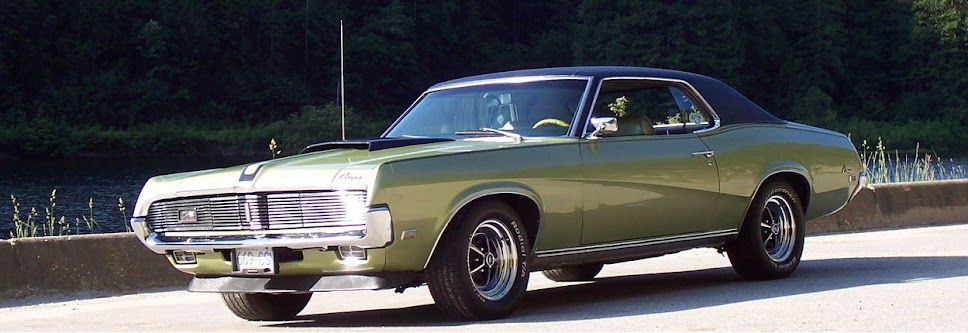
1970 Mercury Cougar Eliminator - Naughty Kitty
October, 2004 By Eric English
Photography by Eric EnglishWhile the Cougar was marketed to an upscale audience, an alter ego could be found in the low-production Eliminator model. Eliminators were primarily a cosmetic package often paired with mainstream 351 powertrains. Check the right boxes, however, and you could have a hardcore performance engine to go along with the Eliminator's brilliant colors, spoilers, hoodscoop, and special trim-the brainchild of the legendary Larry Shinoda.
Take John Benoit's '70 featured here, which was ordered with the ace of all Ford small-blocks-the Boss 302. the Competition Blue beauty is paired with a four-speed Top loader and backed by a bulletproof 9-inch rearend assembly, carrying 3.50 gears and a Traction-Lok differential. Add staggered shocks, a N-case carrier, and 31-spline axles, and you have one bad cat just the way it was assembled some 34 years ago.
One would have to call Benoit more than just your average Cougar buff, as the desirable Mercurys are the main interest at his Cascade Classics restoration business in Edgewood, Washington. Benoit has owned a variety of the models, including Eliminators, GTEs, XR7Gs, and more. he's also been responsible for any number of top-flight restorations.Benoit came by this particular '70 in 1999. he had seen the car in a national competition earlier in the decade. The Eliminator looked terrific as it rolled off the transporter at Benoit's shop, but a more thorough evaluation quickly evolved into disassembly and a freshening to the highest standards. The average hobbyist would have found little fault with the car, but when Cougars are your calling card in life, you want to put your best foot forward. To that end, Brandon Huhtala at Automotive Images applied a new two-stage topcoat. the reassembly involved boxes of N.O.S. trim and chrome. As you can see, the results are nothing short of staggering; a fact borne out by the car achieving 498 out of 500 points at the 2000 Cougar Club of America Nationals.
It's worth noting while the musclecar heavyweight 428CJ was available in all Cougar models, the Boss 302 could only be had with the Eliminator package. In fact, according to Kevin Marti (www.martiauto.com), just 469 Boss Eliminators were assembled during the '70 model year-a mere fraction of the 7,000-plus Boss 302 Mustangs built during the same period. Hardware was pretty much the same for the FoMoCo cousins; the only available transmissions were close-ratio or wide-ratio Top loader four-speeds. An exception to their similarities: the Boss 302 Mustang was available with a Ram-Air, but the Boss 302 Cougar Eliminator was not.
Turning to the interior of Benoit's Eliminator, we see the optional Decor Group trim and eight-track tape player, along with the 8,000-rpm tach dash that came in all Boss Cougars. A factory T-handled Hurst stick actually works Ford linkage, stirring the close-ratio cogs that proved the most popular choice on '70 Boss 302s (Mustang or Cougar). Styled steel wheels were original equipment as well, and mount some of the most popular OE skins of the era-raised white letter Goodyear Polyglas GTs in an F70-14 size.
the Boss 302/Eliminator combination might appear to make strange bedfellows, as the high-rev small-block was primarily a homologation exercise for Ford's Trans-Am race teams, in which the '69-'70 Cougars were not involved.
Three decades later, little has changed, and that's just the way John Benoit and other Boss Cougar fans like it.
PRODUCTION
(courtesy of Marti Autoworks)
1969 1970
Boss 302 Mustang 1,628 7,014
Boss 302 Eliminator 169 469
Saturday, November 14, 2009
Mercury Cougar Holy Grail – West Cost Classic Cougars
In the past month I was on a road tour heading down to San Diego from Kelowna BC and as I headed into Salem Oregon I decided to visit West Coast Classic Cougars.
In the past few years I have procured many parts form West Cost Classic Cougars and I decided to visit this Holy Grail of mercury Cougars.
Don Rush the owner of West Coast Classic Cougars gave me and my wife a personal tour of his facility and I was very impressed with the size of his operation and the many parts that he and his team have parted out.
The very best of the trip was the viewing of a 1969 Mercury Red Convertible with an original Mercury CJ 428 engine which Don Rush was preparing for Barrett Jackson’s.
Dons hospitality was appreciated and his tip of heading down the Oregon coast was the highlight of our next day’s driving.
If you get the chance visit Salem Oregon, I recommend visiting West Coast Classic Cougars and say hi to Don Rush and his team.
Don Robichaud
By Donald Robichaud
In the past few years I have procured many parts form West Cost Classic Cougars and I decided to visit this Holy Grail of mercury Cougars.
Don Rush the owner of West Coast Classic Cougars gave me and my wife a personal tour of his facility and I was very impressed with the size of his operation and the many parts that he and his team have parted out.
The very best of the trip was the viewing of a 1969 Mercury Red Convertible with an original Mercury CJ 428 engine which Don Rush was preparing for Barrett Jackson’s.
Dons hospitality was appreciated and his tip of heading down the Oregon coast was the highlight of our next day’s driving.
If you get the chance visit Salem Oregon, I recommend visiting West Coast Classic Cougars and say hi to Don Rush and his team.
Don Robichaud
By Donald Robichaud
Tuesday, September 15, 2009
1967–1969 Mercury Cougar: Polished Pony
When the Ford Mustang ushered in the pony car era in mid-1964, other domestic manufacturers took notice. The Mustang was an instant success and every division within the Big Three wanted a piece of that pie. Mercury was no exception.
Ford's sister company approached the project with an eye toward not only the Mustang, but toward the bigger, more luxurious Thunderbird as well. The new Mercury would fall somewhere in the middle. It would be aimed at a demographic slightly more sophisticated than the Mustang set, yet not so established as the typical Thunderbird buyer.
Development work commenced immediately, and the Cougar debuted in 1967, sharing the basic platform of the second-generation Mustang, though a bit bigger overall, including a wheelbase increased by three inches. It also shared some components with the Mustang, notably in its mechanicals and cabin, though it was better appointed and priced as such.
Styling was reminiscent of the Mustang shape, but a bit more flowing, with a rocker panel character line and a subtle crease above the front fenders, continuing along the top of the doors, and curving up into a broad C-pillar before ending at the rear of the car. A wide grille with vertical bars concealed the headlights, while a similar treatment at the back concealed the taillights.
The Cougar came only as a two-door hardtop and was an instant success, much the way the Mustang had been. The automotive press lauded it as a luxury sports car, and Motor Trend named it "Car of the Year" for 1967.
Standard power came from a two-barrel 289 V8 delivering 200 hp, though a four-barrel 289 with 225 hp was a popular upgrade. Four transmissions were available, including a 3-speed manual, a heavy-duty 3-speed manual, a 4-speed manual, or the Merc-O-Matic, which now included Select Shift to give the driver more control. While based on the Mustang's suspension, the Cougar offered longer rear leaf springs and stronger spring and axle components to control ride harshness.
A GT package placed a serious emphasis on performance. It included a four-barrel 390-ci V8 with 320 hp, dual exhausts, and a firmer suspension with solid rear bushings, a larger stabilizer bar, fatter tires, power steering, and power brakes with discs up front.
Mid-year, Mercury unveiled the XR-7, a more upscale model with wood-grained interior trim, an overhead console, a T-handle automatic shifter, and combination leather and vinyl seats. Also available as part of the XR-7 package was a Dan Gurney Special, which honored the racer's involvement with Mercury's Trans-Am program.
Mercury upped the options list for 1968, to include Tilt-Away steering, a vinyl roof cover, a basic handling package, several radios, and a sports console. Side marker lights also appeared, now federally mandated. Most notable, however, were the new engines.
A four-barrel 302-ci V8 rated at 230 hp joined the lineup, while a second 390 slotted in below the GT motor at 280 hp. To satisfy the most power-hungry buyers, Mercury offered a 427-ci V8 with 390 hp and a substantial 460 ft-lb of torque, though the motor's weight overwhelmed the car and it was replaced late in the model year by the new 428 Cobra Jet. It was rated at 335 hp, though most people peg the mark closer to 400 horses.
Special models for the 1968 year included the GT-E, which came standard with the big-block engine and Merc-O-Matic, plus stiffer suspension, adjustable shocks, wider tires, quad exhausts, special front and rear grille designs, and unique steel wheels. Meanwhile, the XR-7G furthered the Dan Gurney theme. It offered a hood scoop and hood pins, fog lamps, GT exhaust extensions, and could be optioned with just about any component or engine a customer wanted.
For 1969, Mercury restyled its pony car. Wheelbase remained the same, though the car's other dimensions grew in nearly all directions. Gone was the two-piece grille and its vertical members, and the taillights were revised. Gone also was the rocker character line, replaced by a crease that arced down from the front fender.
Mercury dropped the GT-E and XR-7G, though it added a convertible, as well as an Eliminator hardtop. The Eliminator was comprised of two different equipment groups and included several interior and exterior appointments, such as high-back bucket seats, a unique instrument cluster, a rear spoiler, and styled steel wheels.
A two-barrel 351-ci V8 appeared, putting out 250 hp. It came standard on the Eliminator, but with a four-barrel and 290 hp. Optional on the Eliminator was the 428 CJ.
In its first three years of production, the Cougar sold nearly 365,000 units, though 1967 was its best year, with sales declining every year after. In both pony car and luxury car terms, it did exactly what Mercury hoped it would—bridge the gap between the Mustang and Thunderbird, while offering the best of both cars.
The Cougar name would evolve over time into bigger, slower, less sport-oriented cars, but there's no denying the capabilities and qualities that made the first-generation Cougar so attractive to buyers then and collectors now.
by Max Howard / 2009-05-18
Sunday, September 13, 2009
Sunday, July 19, 2009
1967 Mercury Cougar T/A

The Trans-Am series has inspiredsome fierce rivalries, and one of thefiercest ever raged between the Fordand Lincoln-Mercury divisions in 1967.Led by Sports Car Graphic editor (and,later, AutoWeek correspondent) Jerry Titus,Carroll Shelby’s Mustangs had won thefirst-ever Trans-Am manufacturers’ trophyfor Ford in 1966.
But Dearborn was anxiousto promote the brand-new Mercury Cougarin 1967. So while Ford division retainedShelby’s services for another Mustang effort,Lincoln-Mercury hired NASCAR team ownerBud Moore to prepare a trio of Cougars.Trans-Am cars were different then, farmore like the cars on the showroom floorthan are today’s.
The rules required stockdashboard padding, stock inner door panelsand working window winders with glass inthe doors. The stock unibody was drilled andlightened in places, but relied mostly on theroll cage for stiffening.Dual four-barrel carbs were (theoretically)a parts-counter option for the Cougar’s 289-cid V8.
A hotter cam, headers and as muchporting and polishing as the rules allowedpumped output up to 390 hp. The racingCougar suspension was more stock than not,although the rear leaf springs were supple-mented by a pair of tubulartraction links. Stock brakeswere required, although liningscould be altered, and Mooredrilled holes in the rear drumsfor cooling. For seats (the rulesdemanded two), he chose thesame racing buckets installedin the Shelby GT-350R.
But Dearborn was anxiousto promote the brand-new Mercury Cougarin 1967. So while Ford division retainedShelby’s services for another Mustang effort,Lincoln-Mercury hired NASCAR team ownerBud Moore to prepare a trio of Cougars.Trans-Am cars were different then, farmore like the cars on the showroom floorthan are today’s.
The rules required stockdashboard padding, stock inner door panelsand working window winders with glass inthe doors. The stock unibody was drilled andlightened in places, but relied mostly on theroll cage for stiffening.Dual four-barrel carbs were (theoretically)a parts-counter option for the Cougar’s 289-cid V8.
A hotter cam, headers and as muchporting and polishing as the rules allowedpumped output up to 390 hp. The racingCougar suspension was more stock than not,although the rear leaf springs were supple-mented by a pair of tubulartraction links. Stock brakeswere required, although liningscould be altered, and Mooredrilled holes in the rear drumsfor cooling. For seats (the rulesdemanded two), he chose thesame racing buckets installedin the Shelby GT-350R.
Subscribe to:
Posts (Atom)