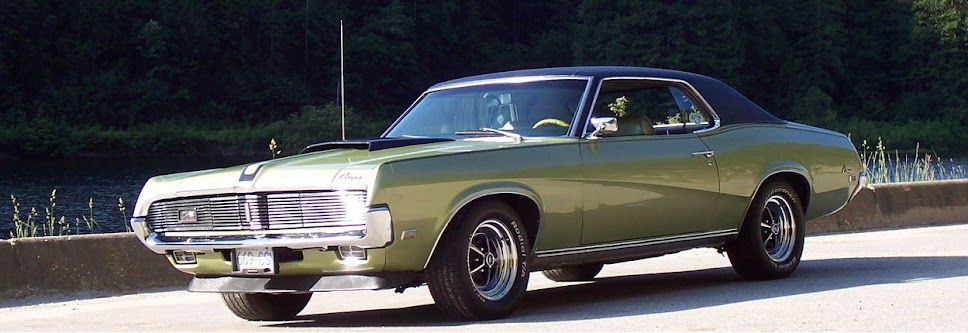
After Mustang’s debut, others tried to cash in on popularity
The Mustang introduced by Ford in mid-1964 launched a new class of automobile dubbed the “pony car.” Its long hood, short deck and low profile made it an immediate marketing success in spite of its mundane Ford Falcon underpinnings.
Imitators followed as quickly as they could, but Ford had sprung such a surprise on the industry that it took Chevrolet until the 1967 model year to respond with its Camaro. This was followed six months later by a Camaro clone, the Pontiac Firebird. Chrysler had introduced the sporty Plymouth Barracuda with its huge, wrap-over rear window at about the same time as the Mustang, but it was overshadowed by Ford’s sensational offering.
The new Mustang created such good publicity and profits for the Ford division that sister division Lincoln-Mercury wanted a pony car, too. But the Mercury product planners had to walk the line with their version to fit it between the Mustang and the Thunderbird. For a more luxurious image, LincolnMercury needed a car that was a little more upscale than the Mustang, yet would still not become a Thunderbird competitor. Projected first-year sales of only 60,000 dictated a modest budget.
Lincoln-Mercury chose the name Cougar to conjure up the image of a lithe, powerful cat. The badge design raised Jaguar’s ire and they resorted to the courts. After some skirmishing, a compromise was reached.
To control costs, Mercury used the Mustang deck lid, roof and inner skin and a good number of its mechanical parts. But Mercury stylists masked them well and were able to give the Cougar its own distinctive persona. They stretched the front fenders and hood, and fitted a split grille with quad headlamps hidden behind doors that formed part of the grille. A kick-up added character to the rear fenders and the Cougar’s long-nose, short-deck profile looked sleeker and more expensive than the angular Mustang’s.
The split, vertical-bar grille was echoed in grilllike embellishments for tail-lights that enclosed the somewhat gimmicky, three-element sequential turn signals.
In keeping with its luxurious pretensions, the Cougar’s 2,824-millimetre wheelbase was 81 mm longer than the Mustang’s. It gave only a marginal increase in interior space. The front coil springs and rear leaf springs were tuned for a softer ride than the Mustang’s.
A more luxuriously appointed interior, including generous use of sound-deadening material, assured a quieter cabin. The Cougar came as a two-door, notchback hardtop only because Mercury’s initial budget didn’t allow for the development of other models.
Although well equipped, the Cougar, like the Mustang, offered a long list of options. The buyer could replace the standard 4.7-litre, 200-horsepower V-8 with a 225-horsepower four-barrel-carburetor version or a 6.4-litre, 320-horsepower “Marauder GT” V-8. A firmer “performance handling package” was available with the 6.4 engine, and a GT version came with the big engine, stiffer springs and shock absorbers, a larger anti-roll bar and wider wheels.
Available transmissions, all floor shifted, were a standard three-speed manual, optional four-speed manual or three-speed “Merc-O-Matic” with “Select Shift” that allowed the driver to control shift points.
The 1967 Cougar made its debut on Sept. 30, 1966, and because of a short supply it was marketed first in California, the theory being that if it sold there it would sell anywhere.
It was well received by the West Coast public and the motoring press, selling far beyond initial expectations. Motor Trend made it their 1967 Car of the Year. The addition of a dressed-up mid-year XR-7 version helped push first-model-year sales to more than 150,000, the best year for the first-generation Cougar.
Performance was middling for the era. Car Life magazine tested a four-speed, 4.7-litre version in February 1967 and recorded zero to 96 km/h in 10.7 seconds and a top speed of 177 km/h for the 1,488kilogram two-door. With the bigger engine it was a different story. Car Life’s July 1967 test of a GT 6.4 automatic recorded zero to 96 in 7.7 seconds, although top speed was up only 8 km/h to 185.
The Cougar was little changed for 1968, but it had turned out to be so popular that Mercury still managed to sell over 113,000 of them. For 1969, the Cougar was restyled and a convertible added. In true Detroit tradition it became longer, lower and wider, already straying from its original pony-car roots.
The name survived until 2002 in the U.S. market (the Mercury brand disappeared from the Canadian market in 1999), by which time it was a crisply styled, front-drive, four-place coupe. To many, however, the “real” Cougars were those original 1960s pony car versions.
From an article in the Vancouver Sun from:
Reflections on Automotive History, by Bill Vance, Volumes I, II and III, are available at bookstores or Eramosa Valley Publishing, Box 370, Rockwood, Ont., N0B 2K0.